If you have more than one child, you’ve probably seen this scene play out before.
One child grabs a toy.
The other child screams.
Someone pushes or hits.
And the parent response we’ve all heard (or said) is:
“Go say sorry.”
But here’s the problem: when kids are upset, forcing an apology usually doesn’t teach what we hope it will.
Instead of learning empathy or repair, children often learn something else entirely.
They learn that “sorry” is just a word adults want to hear to make the problem go away.
Real connection and empathy don’t grow from pressure — they grow from guidance, modeling, and repair.
So instead of forcing apologies, we can help our kids learn something much more valuable: how to repair relationships.
Why “Go Say Sorry” Often Backfires
When a child is dysregulated, their brain is in fight-or-flight mode.
In that moment, they aren’t thinking about empathy or responsibility. They’re overwhelmed, defensive, or frustrated.
When we demand an apology right away, kids often respond by:
- Saying “SORRY!” angrily
- Refusing completely
- Feeling ashamed
- Blaming the other child
None of those responses actually help them learn how to repair the relationship.
What kids need first is regulation and guidance.
The Two Steps That Actually Teach Repair
Instead of jumping straight to “say sorry,” try this simple two-step approach.
Step 1: Help everyone calm down
Before teaching anything, help both children regulate.
You might say:
“Whoa, that was a big moment. Let’s take a breath.”
Or:
“I’m here. Let’s slow down for a second.”
Connection helps their nervous systems settle.
Once emotions calm down, kids are much more able to learn.
Step 2: Guide the repair
Repair means helping children make things right in a way that feels genuine.
And the best way to do that is by giving them words and actions they can use.
Here are some gentle phrases that teach kids how to repair relationships.
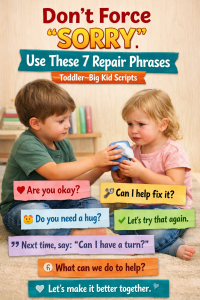
7 Repair Phrases to Try Instead of “Say Sorry”
1. “That hurt your brother/sister. Let’s check if they’re okay.”
This builds empathy without forcing shame.
Example:
“Look at your sister’s face. That hurt. Let’s see if she’s okay.”
2. “What can we do to help them feel better?”
This teaches responsibility and problem-solving.
Kids might suggest:
- A hug
- Getting ice
- Helping rebuild something that was knocked over
- Sharing the toy again
3. “Let’s try that again with gentle hands.”
Kids often need a redo, not punishment.
Example:
“You really wanted the toy. Let’s try asking for a turn instead.”
4. “You can say, ‘Are you okay?’”
Young children often don’t know what to say.
Giving them language helps them practice empathy.
5. “Next time you can say: ‘I’m still using that.’”
Many sibling fights start because kids lack the words they need.
Teaching phrases like this prevents future conflicts.
6. “Would you like to help fix it?”
If something was broken or knocked over, invite them into the repair.
Example:
“Your brother’s tower fell. Do you want to help rebuild it together?”
7. “Let’s make it better together.”
This keeps the focus on connection instead of blame.
Instead of separating kids, you guide them toward reconnection.
What Real Apologies Look Like
When kids are supported through regulation and repair, something interesting happens.
Over time, they start offering apologies on their own.
Because now they actually understand what happened and how their actions affected someone else.
That kind of apology is genuine.
And that’s what builds empathy.
One Simple Way to Teach Repair Before Conflict Happens
Something that helps children learn these skills even faster is seeing repair modeled in stories.
When kids watch characters work through misunderstandings, hurt feelings, and reconnection, they start to understand what healthy relationships look like.
That’s one reason I love reading sibling stories with my kids before bed.
In our home, we often pause during stories and ask things like:
- “How do you think the brother felt there?”
- “What could the sister do to make it better?”
- “Have you ever felt like that?”
Those small conversations build emotional awareness in a natural way.
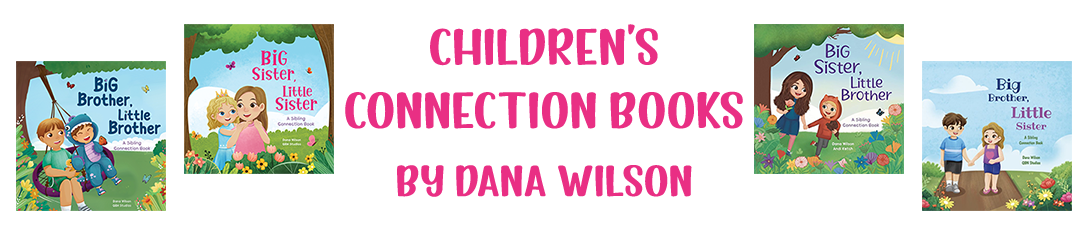
If you’re looking for gentle sibling stories that show connection, understanding, and repair, you can explore the Children’s Connection Books here:
Raising Connected Kids
Teaching kids how to repair relationships is one of the most powerful skills we can give them.
Not just for childhood.
But for friendships, partnerships, and family relationships later in life.
And it doesn’t start with forcing apologies.
It starts with connection, guidance, and repair.
 From Raising Connected Kids — where we talk about gentle parenting, connection, and healing through love.